


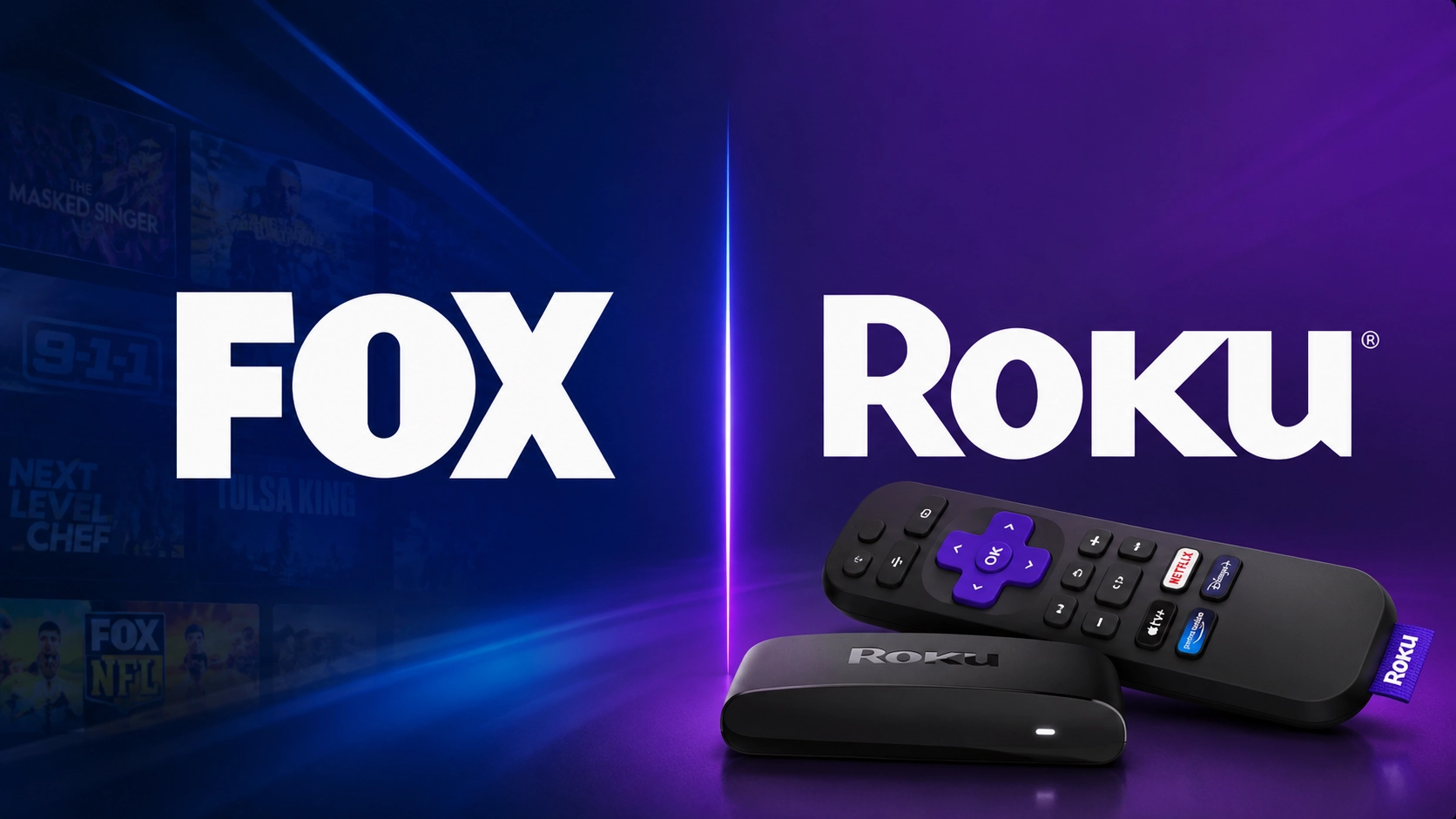
Fox Corporation‘s agreement to acquire Roku for roughly $22 billion is one of the bigger moves the streaming wars have seen yet, and it’s not really about buying another media company. It’s about control, of the screen, the viewer relationship, the advertising pipeline, and the platform that decides what millions of households end up watching on a given night.
For most of the streaming era, the fight was about content. Netflix scaled globally on original series and films. Disney leaned on Marvel, Star Wars, Pixar, ESPN, and Hulu. Warner Bros. Discovery, Paramount, Amazon, and Apple each ran their own version of the same playbook. Fox stayed cautious by comparison, leaning into live sports, news, broadcast TV, and its free service Tubi rather than chasing the subscription race everyone else was running.
This deal changes that posture entirely. Buying one of the most-used streaming platforms moves Fox from being primarily a content company into something closer to a gatekeeper for connected TV. Roku isn’t just an app people open. It’s an operating system, a device business, an advertising platform, and the layer that decides what shows up first when someone turns on their smart TV.
That’s the part that makes this deal significant. Whoever controls the home screen has outsized influence: what gets promoted, what gets recommended, what viewing data gets collected, who gets the ad dollars. Fox already had strong content through sports, news, and Tubi. Roku gives it the front door into the living room that it didn’t have before.
The plan, presumably, is to pair Fox’s content with Roku’s enormous reach into connected-TV households, built through its devices, its OS, and The Roku Channel. For Fox, that reach becomes a real asset as advertisers keep shifting budgets away from cable and toward digital video.
Why Fox Wants Roku Now
The timing tells its own story. Subscriber growth has slowed across the industry, and the focus has shifted toward advertising, bundles, live sports, and free ad-supported tiers. Viewers are tired of paying for five different services. Media companies are tired of subscriptions alone not adding up to profitable streaming businesses.
Roku slots directly into that shift. Owning it gives Fox access to user data, ad inventory, and a sizable existing audience, which matters a lot right now, since connected-TV advertising is one of the fastest-growing corners of the entire industry. Instead of competing for digital ad dollars from the outside, Fox can now compete for them through Roku’s own ecosystem.
There’s a distribution angle here too. Cable operators used to be the gatekeepers who decided whether households could reach a given channel. In streaming, that role has effectively passed to Roku, Amazon Fire TV, Apple TV, Google TV, and the smart-TV makers themselves. They decide what gets discovered and what gets buried. Owning Roku puts Fox on the right side of that gate for the first time.
What Fox can’t do, at least not without real consequences, is turn Roku into a Fox-only storefront. Roku’s whole value proposition rests on staying useful to a wide range of streaming services. If viewers or media partners start to feel the platform is quietly favoring Fox content, that neutrality erodes fast, and so does the trust that makes Roku worth owning in the first place. Managing that tension will probably be the hardest part of making this deal actually work.
It’s also a sign of where the streaming wars have moved. This isn’t only about who has the biggest content library anymore. It’s about platforms, ad tech, user data, and who controls discovery. A great show doesn’t matter much if nobody can find it. This broader shift toward owning the audience relationship rather than just the content shows up elsewhere in entertainment too; see our coverage on entertainment platform strategy for a related example.
For Fox specifically, this could make its streaming business genuinely more competitive. Tubi has already grown into a real free, ad-supported player, and Roku’s platform gives Fox more levers to promote it, bundle content, and target ads more precisely. Pairing that with Fox’s live sports and news could be a meaningful combination if it’s executed well.
The risks are just as real, though. $22 billion is a serious commitment, and investors will expect to see it pay off in growth, not just strategic positioning. Roku is competing in a market where Amazon, Google, Apple, and Samsung are all fighting for the same connected-TV attention. Fox needs to prove this acquisition adds something real without compromising the neutral, open identity that made Roku valuable to begin with.
Regulators will likely be watching too. Media consolidation always raises the same questions, will competitors get fair treatment on a platform now owned by one of their rivals? Promises of openness only go so far before scrutiny sets in, especially in a deal this size.
The bigger picture here is that the streaming wars have moved through phases. First, it was about launching apps. Then it was about racking up subscribers. Now it looks increasingly like it’s about who controls the screen itself, not just what’s playing on it.
Fox’s bet with Roku is that owning the gateway is worth as much as owning the content, maybe more, in a market this crowded. If Fox can actually combine Roku’s reach with its sports, news, and advertising strengths without breaking what makes Roku work, this could meaningfully reshape its position. If the integration gets heavy-handed or just doesn’t move the needle, it becomes a very expensive lesson in an industry that’s already punishing companies for bad bets.
Either way, Fox isn’t sitting on the sidelines of the streaming wars anymore. It just bought its way into one of the most important screens in the fight.

0 Comments